


Page 15 - the NOISE February 2015
P. 15
THE CENTER MULTIPLIES
10X10 + FIRE & WATER
OPPOSITE PAGE ROW 1, FROM LEFT: Diane Scholar’s Spring Thaw, Sunset; Michael Hagelberg’s Lure; Dave Lash’s Chicken; ROW 2 Tina Mion’s Fatal Attraction III; Janeece Henes’ Magpie; Frederica Hall’s Emerging from the Undescribable; ROW 3 Robert Zapanti ‘s Female Cardinal on a Branch; Karen Clarkson’s Medicine Crow; William Ambrose’s Mike; ROW 4 Shawn Shabelund’s Sculpture; Ellen Tibbetts’ Johnny; and Linda Shearer Whiting’s Starrlight Books are all featured at Flagstaff Arts Council’s 10x10 Exhibit, among other fine works from the region’s finest artists.
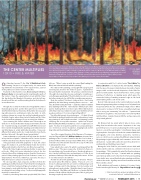
ABOVE: Rebecca Bramon’s Fire Zone at the Jewel Gallery at Coconino Center for the Arts.
BY
CLAIR ANNA ROSE
On Saturday, January 17, the 10 x 10 Exhibition & Sale, tells me. “When I came up with the name, Blind Leading the
In conjunction with 10 x 10 at the Center, “Fire & Water” by Rebecca Bramon is on display in the Jewel Gallery. Walking into the space, the viewer stands between two walls of water images, while on the back wall, depictions of the Slide Fire glow in a warm palette. A personal favorite is Source, a large painting of reflections on rippling water, which gives the viewer the feeling of standing at water’s edge at Oak Creek and breathing in the scent of wet earth.
Born in Utah and raised on the Central California Coast, Ms. Bramon began painting after receiving a set of oil paints from her parents when she was a freshman in high school. When she moved to Sedona in 1976, “it was a beautiful, small town with a strong art community,” she tells me. “I painted and worked in local galleries. Ten years later, I moved to Key West and then Maui. I painted tropical still lifes and was represent- ed by island galleries.”
Ms. Bramon tells me about what it takes to move some- thing from her mind to the canvas: “Inspiration is the easy part of the process. It can be a walk along the creek or a great label on a can in the recycling bin. Something is always perk- ing in my brain. I have piles of notebooks crammed with ideas, photographs, color notes, sketches and poetry. I work in a series so I don’t become scattered by different subject matter. My paintings begin realistically and sometimes evolve into abstractions. I paint with acrylics because they allow me to work quickly and build layer upon layer.”
During the 2014 Slide Fire, the outside air was thick with smoke and the artist was confined to the indoors to work on her paintings. “I felt compelled to paint Fire Zone based upon local media images,” she says. “I started with one painting and ended up with a ten foot by four foot five panel painting. In my studio were several finished water paintings and three others in the works. A gallery owner friend saw them and said,
‘This looks like a show.’”
Both exhibitions will remain on display at Coconino Center
for the Arts through February 14. FlagstaffArtsCouncil.org
| Clair Anna Rose enjoys reading until her contacts fall out. editor@thenoise.us
featuring 124 pieces of original art by 100 artists work- ing within the measurements of 100 square inches, opened to the public at Coconino Center for the Arts.
Featured on this month’s cover, Blind Leading the Blind, by Rebecca Slater, is among the works now lining the walls of the Center. I have the opportunity to meet with Ms. Slater the day before the Member’s Reception, and she tells me about herself, her art, and the painting that has fueled much recent discussion.
Though she recently moved back to Flagstaff, Ms. Slater’s husband grew up here and she first came here in 1996 to at- tend Northern Arizona University. At that time she was paint- ing with watercolor, and trying to refine her skills. In 2003, seeking a change in scenery, she and her husband moved to Portland, Oregon, where they started a family, and Ms. Slater took a break from painting to focus on raising her children.
Upon returning, Ms. Slater’s children were old enough to at- tend school. “It was the first time I had spare work time,”she tells me. “I started messing around with new stuff. When we moved here I started doing illustrative paintings and really weird, sur- real little figures in acrylic with India ink outline. It was very different from what I used to do. I really started to hone that in, but then I hit a wall. I thought, I know I can go further.”
It was at that time, a year and a half ago, that she decided to buy her first oil paints. “I think the reason I never oil paint- ed before was that I was afraid to try it in some sense.”
Using just black and white pigments to start, Ms. Slater began her study in oil, and immediately found she loved it. While acrylic dried too fast for her, oils offered an easy flow.
Before Ms. Slater begins a painting, she likes to peruse her art books. While she’s never attended art school, she has educated herself by studying masters from the Renaissance period. Older paintings give her a feel of what to create, or a temperament. “A look on a child’s face, a gesture,” she says, is what she hopes to carry across in her work.
“I’ll come up with a main character, and then I’ll form the painting around that character. That’s how the story happens. I have a hard time having it all figured out when I start. I’ve been trying to work with that idea of people and characters in settings who are telling a story. I’ve been really happy with how they’ve turned out.”
“I want to paint things that make people think,” Ms. Slater
Blind, I was almost finished with the painting.”
The subject of the painting, a young girl with a peg leg and
unseeing eyes, beckons the viewer to pause. “I painted her first and I had her in my mind. Her arm was outstretched and I thought she looked like she was reaching for something, or something was guiding her.” Then the balloon took to a corner, but after painting it, she still felt like something was missing.
Next, she realized, “Oh, there’s a baby in there. She’s being guided by this blind thing, assuming fetuses can’t see ... this idea, the blind leading the blind — anybody could be led blind- ly by anything in their life. I don’t want to offend people. But I want to challenge them to be more open. When I did my show at Rooftop Solar I was really nervous because I didn’t know how people would react. It’s not your typical Flagstaff art.”
“I’m still really trying to learn techniques ... It’s kind of hard, but I think I’m getting slowly better with each painting. I want my paintings to still look photorealistic. Oil painting is really satisfying, but it’s very labor intensive. I paint lots of layers. Blind Leading the Blind probably has seven or eight layers of paint. You have to be patient, and I’m not a very patient per- son. It’s been an exercise in patience, stepping back and let- ting it dry and then thinking, ‘Now what?’”
One of the original founders of the Museum of Contempo- rary Art Flagstaff (MOCAF) William Ambrose, donated two paintings to the Coconino Center for the Arts 10 x 10 show, a portrait of Bruce Aiken and a portrait of Mike Frick. He takes some time out of his week to meet me for a cup of coffee and to talk about the show.
“I was asked to be a part of it, which is exciting and fun,” Mr. Ambrose says. “The space is awesome. It’s kind of a chance to do something out of your wheel house. Everybody who goes into it works in different sizes and mediums, so it’s like an ex- periment of what you’ll do with this tiny, little canvas. It’s fun to see what everyone else will do.”
He tells me about the paintings he has donated. “They’re like inside jokes,” Mr. Ambrose admits. “If you do a 10 x 10 show, it’s asking people who are used to working longer and larger on things and it’s like taking a short story writer and asking them to write a haiku. I think this time for me it’s more like a limerick. I like Mike and I like Bruce, so I made silly little pictures of both of them. My favorite part of this is going and meeting everybody at the show.”
thenoise.us • the NOISE arts & news • FEBRUARY 2015 • 15


