


Page 36 - the NOISE February 2015
P. 36
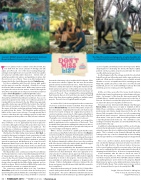
FROM LEFT: RE Wall’s Granite Creek Mural; Kristin Anthony’s The City of Prescott is now laying out a core plan for public art, Mosaic Art Bench; & Solon Borglum’s Rough Rider. to counter past discrepancies that diminished artistic intent.
There are plenty of arts ‘n culture events this month, but let’s shift from the usual calendar of shindigs and talk public art in Prescott. One of the most exciting things hap-
pening in town right now is not a specific event, but a public arts proposal currently under discussion. Several cities al- ready have public arts policies and guidelines in place, but Prescott is not one of them. There is an effort underway to change that, led by Smoki Museum director Cindy Gresser.
For those unfamiliar with Prescott’s history with public art, this may not seem like a big deal. Actually, it is a huge deal for this little mountain town. While many visitors easily recognize the various bronze statues scattered throughout town, Prescott’s public art encompasses more than acclaimed sculptor Solon Borglum’s beautiful Rough Rider statue.
Historically, the city’s public art policy has not been codi- fied, and has shifted from politician to politician. As a case in point, the popular bronze statue on Courthouse grounds of Cowboy at Rest was donated to the city. While it was generally agreed the statue was a good fit for the location, the city had little interest in paying to transport the statue. Supposedly, the mayor at the time ended up getting a family member to go and pick up the statue. This illustrates pretty well how public art has come to pass in town. If enough people like it, someone other than the city is willing to pay for it, and it has the tacit approval of the politicos in office, the art is allowed.
The practice of choosing public art based on loosely held ideas of what is or is not appropriate has been in place for some time, although in the past few years there have been some serious disputes and challenges over public art. The most famous, or infamous, example is the controversy over the Miller Valley Elementary School Go on Green mural in 2010.
Well before the Miller Valley mural project, R.E. Wall co- created his first mural on Granite Creek, near Gurley & South Granite Street. Working with a group of other artists, com- munity volunteers and school children sparked an enduring interest in mural work. Mr. Wall went on to create Prescott’s Downtown Mural Project, the Mural Mice, and the group completed three major mural projects in the area before tak- ing on the Miller Valley project concurrently with another mu- ral project in Acker Park.
The Mural Mice were commissioned by Prescott Alterna- tive Transportation to create a mural illustrating “green” forms of transportation kids can use. As the only certified “green” school in the Prescott Unified School District at the time, it seemed like a perfect fit for a mural. The artists worked with design ideas brought by the Miller Valley students and cre- ated Go on Green. Artists, students at Miller Valley, and volun- teers worked for months to complete the mural.
The controversy exploded when local City Councilman Steve Blair spoke on his local radio show about the project, questioning why a black child was the central figure in the mu- ral. The figure in question was, in fact, modeled on a real stu-
dent at the elementary school and that child is Hispanic. After the artists were asked to “lighten” the skin tone, the incident gained national and international notice. Under the pressure of intense scrutiny, the request to change the mural was with- drawn and an uneasy truce on the public art issue was struck.
Go on Green proved to be the Mural Project’s last major art venture in Prescott. They completed the stunning Melting Point mural in Mesa in 2012 and then relocated to Flagstaff, where they have been working steadily on multiple mural projects. Prescott’s loss is Flagstaff’s public art gain.
In October of 2011, the issue reignited over the construction of a mosaic art bench in Granite Creek Park. Prescott College student Kristin Anthony conceived of the public art piece as her senior project. Inspired by the benches she had encoun- tered in her travels in Nepal, her original idea had been to construct a simple concrete bench. After approaching Parks & Recreation for permission, she then began to explore the idea of using the core concrete bench as a base for a mosaic.
As the project expanded, Ms. Anthony encouraged the public to participate in the construction of the bench. That snowballed into participants adding their own mosaic tiles to the design, including memorials to people who had passed on, police badges and religious symbols.
While a mosaic art bench in a public park hardly seems controversial, acting Parks & Recreation director Joe Baynes received a handful of complaints from the public and went to see the bench for the first time. After looking at the project, some safety concerns were noted over possible sharp edges. Ms. Anthony attempted to address those issues by consulting with other mosaic artists who made simple, practical sugges- tions to make the bench safe and comfortable.
The waters were muddied by the disparities between Ms. Anthony’s original plan to construct an unadorned bench and the mosaic that developed. There also appeared to be a fair amount of confusion about approval of the project, as one of Ms. Anthony’s contacts at Parks & Recreation regularly stopped by to check on her progress. However, this person was evidently not authorized to approve or disapprove the changes. Endless challenging conferences between Ms. An- thony and various city officials were held, but little seemed to be accomplished.
Very early on the morning of October 26, 2011, Parks & Rec- reation destroyed the bench in Granite Creek Park. No warn- ing was given. This action effectively ended the discussion on whether the bench should stay or go, and brought the dis-
cussion of public art firmly back into the foreground. While unapologetic for destroying the bench, Mr. Baynes rightly pointed out that a public art policy would make the tussle over Ms. Anthony’s project moot.
As often happens, after the outrage and calls for action had faded, Prescott was left pretty much in the same position on public art. What exactly constitutes a piece of public art and whether or not it is acceptable was left in a murky gray area. Many felt a public arts policy could save a lot of hassle and heartbreak, yet no one seemed willing to take up the hard work that goes into creating a model of guidelines.
A little over three years after the mosaic bench debacle, the first steps toward creating a more rational approach were taken. On January 6 of this year, Ms. Gresser presented “Art in Public Places,” a public arts policy proposal, to the City of Prescott. Ms. Gresser considers this proposal to be “a very ba- sic start to the discussion of public art in Prescott.”
The proposal was developed with Deputy City Manager, Alison Zelms and lays out a core plan to establish an Art in Public Places committee, comprised of working artists, arts professionals and citizens deeply interested in the arts. Ms. Gresser fully recognizes the policy is not all encompassing and will not please everyone. However, she believes it will allow artists a clear process with reasonable guidelines and a reporting body based in the arts. The committee is also seeking to inventory the public art currently within Prescott, another first for the city.
In addition to alleviating potential conflicts, such as the Go on Green mural and Granite Creek Park mosaic bench, a public arts policy opens the door to additional arts funding through grants. This is certainly a step forward, although any artists looking to the city council to dramatically increase funding and arts opportunities are very likely going to be disappointed.
This is not a perfect solution, but moving from conflict into constructive dialogue and a basic structure is a welcome step in the right direction. Ms. Gresser made a strong case to the council, underscoring the economic value of arts tour- ism, and is confident that the city understands the benefit of adopting Art in Public Places. A decision is expected shortly.
In the meantime, take the time to check out some of Prescott’s finest public art. There are several works on the Courthouse Square, but the Prescott Public Library is within easy walking distance and is home to the gorgeous Beyond Words mural as well as some whimsical bronze statues by lo- cal artist Heather Beary. Take a walk, open your eyes and en- joy it. It was put there for you to do exactly that.
Angie Johnson-Schmit is taking her time to stop & see the murals. angie@thenoise.us
36 • FEBRUARY 2015 • the NOISE arts & news • thenoise.us


