


Page 33 - the NOISE December 2012
P. 33
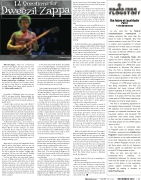
Dweezil Zappa, eldest son of American Treasure, Frank Zappa, has had a varied career as actor, musician, and composer. He cam- eoed in Pretty In Pink, held air time as a VJ on MTV, voiced a character on the animated series Duckman, wrote and performed the theme for the Ben Stiller Show, and has lent his talents to the likes of Weird Al yankovic, Ozzy Os- bourne, Spinal Tap, and Winger. Since releas- ing several solo albums, he’s recently invoked the legacy of his father in orchestrating the touring Zappa Plays Zappa, which appears at the Orpheum December 16.
According to Wikipedia, when you were an MTV VJ, you were fired for “bad-mouthing” the network on the Howard Stern Show. What did you say that caused such an uproar among cor- porate execs?
I wasn’t under contract. I was only a fill in VJ on occasion. People had the impression that I was on there all of the time but I only ever did 12 weeks of work over 2 years. I did continue to do stuff for MTV even after the Howard Stern interview but there were a folks who didn’t like that interview. I can’t recall exactly what I said but there was a floor producer who would burn my segments if I said anything he didn’t like.
At that time there were a lot of videos in heavy rotation that I couldn’t resist making a snarky comment about. Things like Lionel Ritchie “Dancin’ On The Ceiling.” I also made a comment about 7-Up’s ad slogan: “Feel So Good Coming Down.” I questioned the mean- ing of that on camera and since they were pay- ing for the advertising, I think MTV was con- cerned they would stop advertising. I was 17 and just making a joke.
Many who’ve enjoyed the Zappa label find it hard to believe your father’s only vice was cof- fee and cigarettes, that despite his avant garde lyrics and compositions, that he may have been the first to advocate the modern “straight-edge” movement. Did you ever find yourself “butting heads” with him as an experimental teenager?
It’s true, my father was very much against the use of drugs and alcohol. It’s far more im- pressive to be creative without the use of mind altering substances. I’ve never taken a drug, smoked a cigarette or been drunk in my whole life. I’ve never had any interest in it and have always steered clear of it in any social environ- ment. For me to have been rebellious in my family I would have had to become an accoun- tant or a lawyer.
by omar Victor
In the mid-1990s, Frank became the leading voice in the fight against censorship after the 2LiveCrew flare up and Tipper Gore’s efforts to la- bel “obscene” material. Do you find yourself shar- ing political views with your father?
I have always been in agreement with my father’s outlook on politics but I have not been active in voicing that agreement. I really prefer to stay away from that arena. I’m glad that Mitt Romney was thwarted once again and his bid for the presidency was unsuccessful.
Some imagine growing up in the Zappa house- hold as being a panacea of creativity and musi- cal experimentation. Can you relate a story as to what it was like? How did you discover your tal- ents as a musician and composer, both with and without your father?
Every family has their own sense of what is normal and for us music and creativity was normal. We were encouraged to find our own interests and pursue them. When I became se- rious about music my dad had lots of construc- tive criticism and advice. He most certainly was careful to explain that the music business had nothing to do with talent and that develop- ing skill and talent did not mean that it would equate to success in the industry.
He didn’t dissuade me from continuing my interest in music but he did clarify the reality of how the business works. I was motivated to be a technically proficient guitarist. I always planned that one day I would be able to play some of my father’s most difficult music on gui- tar. In 2006 that is when I was ready to show everyone what I had been working on.
Your previous incarnations on YouTube reveal a “hair rock” persona that’s been compared to David Lee Roth of Van Halen. Did you ever meet
“delicate Dave” and how have your musical tastes progressed since releasing “Got to Get to You”?
I’ve met David Lee Roth. I always appreci- ated his ability to make things larger than life. When I was 17 he was fronting the biggest rock band in the universe with my favorite guitarist, Edward Van Halen. So I was inspired and influ- enced by him.
I have always had a lot of different musical interests. Having played in Zappa Plays Zappa for almost a decade, I’ve discovered many new things as well. The next record I make will re- veal a very different side of my own music.
You’ve said in previous interviews that it took you two years to learn the songs you are currently playing on tour. What were some of the chal- lenges in learning the music? Are there times you
feel as if you’ve been “check mated” by a certain
riff or orchestration? Do you ever feel as if you are “channeling” your father?
The music has always been inspirational in many ways. One of those ways was to moti- vate me to enhance my abilities as a guitarist through learning new techniques in order to tackle some of the most challenging melodies. There has yet to be a piece of music that we have taken on that we have not been able to play.
Some things are very, very difficult and on stage, conditions change, making some thing much more difficult to execute accurately on a consistent basis. On this current tour, “Strictly Genteel” has been very difficult to play. When I solo I do feel as though I am able to tap into a zone that is sometimes eerily close to my dad’s playing.
It’s been reported you are working with Gibson to release a guitar modeled after Frank’s legend- ary “Roxy SG.” What are some of the specs of this guitar, how are you dialing it in on tour, and when do you expect a commercial release?
I have been playing the prototype on tour these past few shows and I love it. It sounds great and it plays fantastically well. It’s been made to the same spec as my dad’s Roxy SG. The neck is the same and the electronics are the same. I hope it will be available early next year.
Strangely, your father probably received more radio air time in Europe than in the States. How has this effected the tour being received thus far, both at home and abroad? Do you feel you’re ac- complishing what you’ve said prompted you to do this in the first place, namely to bring aware- ness of Frank’s music to a new generation?
My dad didn’t get a lot of radio exposure in most places. What did get on the radio was not completely representative of the depth and variety within his music. That is part of what I wanted to change. I wanted to give people an opportunity to see a wide variety of his music and make particular emphasis on the things I thought were overlooked or under appreci- ated about his compositional style.
That is why we have focused on much of the difficult instrumental music. I also wanted to make that my father’s music had a chance to be carried forward into the future by a new and younger generation. I know we have ac- complished what we set out to do because the audience looks very different now. The first time around it was all older guys in their 50s- 70s, very few kids and even less women. Now there are lots of younger fans, right down into the teens. There are also a lot more women. Women who have tattoos of my dad even.
What is the playlist like this tour? Any chance Moon will make a guest appearance in a “Valley Girl” reprise? What’s the one song you’ll be play- ing you believe everyone should be listening to?
My Sister did perform “Valley Girl” with us in 2010 in London, she won’t be joining us on that tune this time around. There are so many great pieces of music to choose from it’s difficult to choose just one. One of my all time favorites is
“Dog Meat,” also know as the “Dog Breath Varia- tions.” The Yellow Shark version is definitely worth checking out.
Any last words on this tour or anything else you’d like to mention?
We have describing this current tour as a de- cades tour because it features songs from the 60s, 70s and 80s. The setlist has a lot of fun high energy, rocking teenage combo tunes and a few very difficult master compositions. There is a lot of variety in the show. I hope people will come check it out.
thenoise.us • the NOISE arts & news
• DECEMBER 2012 • 33
The Future of Local Radio Part 3
by John Abrahamsen
As you read this, the Federal Communications Commission is making decisions that could alter the future of radio in Flagstaff. Now that election season is over, the FCC is back in session and considering if it should eliminate the 10-watt class of low-power FM community stations, and create a new class of 250-watt LPFMs for small markets such as Flagstaff.
The Local Community Radio Act signed into law in January 2011 allows more frequency space for LPFMs, and places obligations on LPFMs that cause interference to full-power FM stations. Now, the FCC is deciding how those obligations will be interpreted, and in what circumstances a low-power station will have to cease operations in the event of interference to a full-power station.
Proposals on LPFM power levels are also being considered. The FCC has authorized but never licensed LPFM stations operating at 10 watts, and is now thinking of doing away with this class of station. In its place, the FCC may create a new class of LPFM station operating at 250 watts, but only for small markets.
The FCC is considering arguments for and against these proposals. Full-power FM operators are concerned about the prospect of increased interference from low-power stations, and low-power FM proponents want these issues settled so they can find a frequency before the next filing window for new LPFM stations opens in 2013.
So, the future of community radio in Flagstaff could be decided before Christmas—everyone here at Radio Free Flagstaff is eagerly awaiting the outcome of this session, so our radio engineer will know what frequencies will be available for an LPFM in Flagstaff. As soon as we get those specs, we’ll do our frequency search, submit our application and wait for that FCC filing window to open.
While we wait, we’ll get back to fundraising—we’re planning an entertaining fundraiser for January, and we’ll have the details for you in the next issue of the Noise. In the meanwhile, please support community radio in Flagstaff by making a donation at RadioFreeFlag.org.
12 Questions for Dweezil Zappa


