


Page 24 - The NOISE December 2015
P. 24
SPEAKING BOLDLY
MAKING PRINTS WITH A STEAMROLLER AT NAU
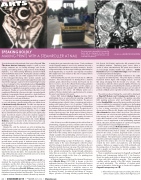
The prints made during NAU’s Steamroller Event will be displayed for the month of December at Flagstaff Modern and Contemporary Gallery.
STORY BY ALISON KLION
It is the first truly cold weekend of the year in Flagstaff. The Northern Arizona University campus is quiet, as most college campuses are on Sunday mornings, save for the cleanup crew taking down a stage in front of the Walkup Skydome. It is Homecoming Weekend, and the football team beat Weber State 52-36. Passing the campus’s striking ceramics complex, the air smells vaguely of wood smoke. A few beleaguered-looking older women wander past, informing someone with a university badge they really need much better signage. I agree; I’ve been wandering for nearly an hour looking for the misleadingly named Steamroller Print Event (while the steamroller took center stage, other activities were arguably more popular as anyone was able to participate). Finally, as I ascend the hill past the kilns I reach a parking lot flanked by a few non-descript corrugated metal buildings. Large printed sheets, pinned to a chain-link fence, flutter in the wind. I’ve managed to navigate the campus in the pine forest to reach my destination.
I come upon an outdoor printmaking workshop, centered on one man driving a small asphalt roller over inked sheets of Medium-Density Fiberboard. The NAU art department advertised the event as an opportunity to see the production of large-scale art, and they aren’t kidding. This is no small scale. Each student has carved an image into a sheet of MDF that is at minimum four feet square, but most are significantly larger. Each block requires at least two students equipped with heavy duty rolling pins to cover the whole surface to be printed with viscous oil-based black ink. Inside, Dennis McGinnis, who is a lecturer in the school of art, mixes up pints of ink with Vaseline like a baker mixing icing for a goth wedding cake.
Despite the cold, the students are all in matching blue t-shirts, because even on a more traditional small-scale job, printmaking is a labor-intensive process, requiring speed and a decent amount of muscle. One usually works up a sweat while printing. A student is furiously inking a block when two students notice the ink is beginning to dry, and they jump in to help her. Once it is inked, the block is transferred to the ground where another group of students swarm around to cover it with a sheet of muslin, which takes the ink. A layer of foam padding protects it from direct contact with the roller. With that, the lights of the machine blink on, and a quiet man makes two passes over it, applying consistent pressure to transfer the ink onto the fabric. The steamroller slips off the edge of the print and a team of students rush over to reveal the print to a cheering audience.
This is only the second year the NAU School of Art has included the steamroller printmaking event as part of its curriculum, and the first other activities have occurred in conjunction with it to create a department-wide happening. Professor of Printmaking, David R. Williams, explained they began the event last year to generate more interest in the art department among students and the public. The inclusion of sculpture and art education activities allowed any attendee
to make their own artwork to take home. Total enrollment on the Flagstaff campus is over 20,000 students, but only a tiny fraction of the graduates are studio art majors. At such a large university it can be a major challenge, particularly for small departments, to reach the vast majority of students who might never even venture to the side of campus where art classes are held.
Unfortunately, this year the school of art was in a difficult situation. The event depends on funding from a student activities grant, which they received, but found out too late to reserve a slot in the official Homecoming activities calendar. Despite the lack of awareness on the campus as a whole, students who graduate with a BFA from NAU are incredibly loyal to the school. Mr. Williams points out a number of former students who eagerly returned to campus this year to participate in the event.
Former NAU student Andrea Bagdon describes NAU’s printmaking classes as very technical, requiring a significant commitment of studio time from the students. The process for making any type of print is time consuming, and involves making and learning from a lot of mistakes. Rather than spending much time focusing on the history of printmaking, the students dive into their work headfirst. The prints boast a wide range of influences and styles: Anime and other cartoons beside activist posters, Van Gogh inspired Grand Canyons and Pulp Fiction/Daft Punk appropriation mash-up. There are pieces that evoke a rustic, feminine iconography evocative of the Pacific Northwest, lush landscapes and stark portraits.
A bit of history: woodblock printing is the earliest form of printmaking, originating in China sometime before the ninth century, spreading westwards through the Islamic world and arriving in Europe around the 13th century as a method for stamping designs onto textiles. It was not until the second half of the 14th century, when inexpensive paper became reliably available, that printmaking achieved success as a mode of commercial reproduction and as an artistic medium in Europe.
Woodblock printing is a type of relief process. Imagine a rubber stamp or the classic kindergarten craft, the potato print: the image to be printed stands in relief above the rest of the block, which has been cut away. The artist must carve away from their block everything except the lines or shapes to be printed, producing the design through elimination rather than an accretion. Once ink is applied to the block, vertical pressure, usually in the form of a printing press, transfers it to a piece of paper.
In Western European art history, the German Renaissance artist Albrecht Dürer (1471-1528) is known as the first undisputed master of the woodcut. He achieved a fineness of line, intricacy of detail, and variety of tone that set him apart from his predecessors. I would be remiss to not acknowledge the Japanese are arguably more important in the history of prints. According to the Library of Congress, Ukiyo-e (pictures of floating worlds), popular during the
Edo Period (1615-1868), exploit the full potential of the woodblock medium. Depicting genre scenes (often a world of urban entertainment), the prints were aimed at an increasingly wealthy middle class audience. Suzuki Harunobu (1725-70) and Ando Hiroshige (1797-1858) were considered preeminent designers.
I noticed one block particularly indebted to the study of Japanese woodblock prints. The print depicts a horned, humanoid demon figure with bulging muscles and bat- like wings emerging from the mouth of a volcano. The composition, with the demon placed slightly off-center, its face turned outward as if startled by the viewer, as well as the flatness of the figure and lack of illusory space, are evocative of portraits of kabuki actors or geishas common in Ukiyo-e prints.
The prints produced during the event will be displayed at Flagstaff Modern and Contemporary Gallery in an exhibition that opens in December. The gallery, owned by NAU painting professor, artist and Flagstaff community leader, Franklin Willis, opened last spring, and has in its short tenure, established a reputation for putting on challenging, contemporary exhibitions. FMAC, as it’s colloquially referred to, has a strong connection to the university, both the aforementioned Director Ms. Bagdon and Assistant Director Gabe Schmadel are alums of the school of art. The collective of artists who not only show at the gallery regularly, but also help manage the space, include a number of current and former NAU students as well. Participating in the exhibition will be a sort of supplement to the printmaking students’ artistic education, introducing them to a professional gallery setting and how to hang and light their work.
Senior studio art major, McKenzie Dankert relishes in the opportunity to work with FMAC, as it assures a wider audience for her work than it has had on campus. She produced two prints for the event, a totemic stag head under a crescent moon, a piece for her father; and a more introspective piece titled, Oblivion. The latter features a female figure with bare shoulders and braids wrapped around her head. She faces away from the viewer, who sees her through a window created by deer antlers and jawbones, and blooming poppies. Both pieces suggest a cycle of life and death, and the juxtaposition of masculine and feminine energies. Her work is graphic and lovely, tied to ancient symbolism and personal mythology.
There is significant young talent in Flagstaff, and Flagstaff Modern and Contemporary Gallery, 215 S. San Francisco Street, has made great strides to bring it to the community at large with their exhibition program. Their growth as a gallery, and the growth of the NAU artistic community are much anticipated. The exhibition of student prints opens in December; follow them on Facebook for updates. Flagstaffcontemporary.com
| Allison Klion thought about ending this with a James Taylor quote. allison.klion@gmail.com
24 • december 2015 • the NOISE arts & news • thenoise.us thenoise.us • the NOISE arts & news • DECEMBER 2015 • 23


