


Page 24 - the NOISE February 2015
P. 24
UNCOVERING THE HISTORY & REINVENTING THE MYSTERY:
The Metal Sculpture of Bernie Molaskey
STORY BY SARAH GIANELLI
Asteep, bumpy road climbs high above Clarkdale’s Yavapai College before opening up into expansive views of Sedona in one direction, and the green-treed slopes of Mingus Mountain in the other. Perched on the ridge in between is the home-gallery, sculpture garden and workshop of metal artist Bernie Molaskey.
Welcoming me inside, Mr. Molaskey jokes that he is the featured artist in this house. At the far end of the main hallway, the unmistakable shape of a bird, reduced to its simplest, elegant lines of steel, pops against the orange-walled alcove in which it is set. The body of Raven Three Forks is made out of the prongs of three pitchforks. A pointy old tractor part forms its beak and dips on a natural pivot. Mr. Molaskey made the piece in 2009 for a kinetic sculpture assignment in his first welding class at Prescott’s Yavapai College. It won Best in Show in the student exhibition, and went on to spend six months in the gallery at Phoenix Sky Harbor Airport.
Mr. Molaskey is a minimalist when it comes to sculpture, using as few components as possible, and rarely manipulating them beyond cutting and then seamlessly welding them back together in a different configuration.
“I try to stay as natural as possible,” he says. “For me, rust is an important aspect of what I do. It can be difficult because sometimes you want to preserve things or make them look nice, but I really try to allow nature to continue to participate in the piece, destroying what man has made, and what I have made.”
An early example of Mr. Molaskey’s ongoing shift from the abstract toward the anthropomorphic is Soul Wrenching, a small figure made of antique monkey wrenches. He added Buddha- lobed ears to the “head,” and inserted an oblong Quartz crystal as the primary focal point, like a third eye, creating a striking contrast between the clear, glinting crystal and dark, heavy steel.
One of the wrenches forming the legs is shorter than the other, giving the impression the figure is walking; and a worn leather pad, once a hand grip for the tool, suggests the sole of a shoe.
“I love the history to these pieces,” he says. “That’s why found object art is such a big thing for me. You can tell they’re old; they come with a mystery ... sometimes you can figure out what they are, sometimes you can’t. You can see they’ve been used for decades and decades, maybe through generations of a family. I like to think there’s a little spark of spirit or energy to them ... a little piece of the person or persons who used it. There is also the original designer of the tool, who 50 or 100 years ago actually crafted things with an artistic flair. So you’ve got the designer, then you’ve got the user or users, then you have the finder — which in many cases is me — and then I put it together in a new form.”
Prior to devoting himself to his art five years ago, Mr. Molaskey spent 20 years in the aerospace industry as a microcircuit engineer, followed by 15 years owning a web development business. He started collecting rusty farm equipment and tools 20 years ago and was using them to adorn his New River home,
when he became inspired by his neighbor, jeweler Kit Carson, to do something more with the rusty relics. He wasn’t skilled in welding at the time so he stuck to stacked designs, like the three large abstracts outside his kitchen window. Reminiscent of ancient urns, the bottom-heavy pieces each weigh 400 pounds, and were created out of the barrel of a cement mixer, and two giant brake drums that spire up into ornate finials. Mr. Molaskey named the series “The Three Gifts,” because they reminded him of the offerings of the three wise men.
Winding through the outdoor sculpture garden are pagoda- like structures and pterodactyl-esque light sculptures, and another kinetic piece created out of an old Edison-style megaphone that scans back and forth on the slightest breeze, giving the eerie impression of being listened to.
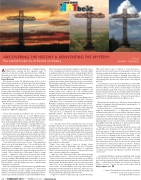
Finally, we come face to face with the commanding presence of a cross comprised almost entirely of rusty nails. The piece, called Miner’s Cross, is somewhat of an anomaly amongst Mr. Molaskey’s sculptural creations, but one of his most powerful.
Mr. Molaskey identifies as a Buddhist, but his Catholic roots run deep and its symbolism shows up in his work, although typically more subtly, and with less denominational fervor.
The piece was a commission for Jerome’s Haven United Methodist Church. The former pastor wanted a cross that would relate to Jerome and its history, and Mr. Molaskey agreed to make one free of charge if he could have creative input in the project.
“So I brought Pastor Vicki [Lerdahl] this idea, and she thought it was great so we started soliciting members of the church and other people in town for nails. Soon people are finding nails in their gardens, while walking their dog, and in their basements, and I would walk through town and people would come up to me and go, ‘Bernie, I’ve got a nail for you!’ So I got this connection with the community I never would have if I was making something out of clay or oil paints or anything else ... and the community became a part of the piece, which is so important.”
Miner’s Cross never found a home in Jerome’s Haven Church because United Methodists, like most Protestant denominations, use the cross as its symbol to emphasize Christ’s resurrection, not the crucifixion, so the piece stirred up some controversy within the congregation.
“I think one or two of the major elders of the church thought this was a little too much ... I mean, it is nails to the nth degree.” But a closer look reveals much more than nails. One could get lost discovering the many small symbolic pieces hidden in the thorny jumble. An abstracted face coalesces in the top portion of the cross, an eye emerging from the handle of corroded scissors; there are small hammers, and rusty odds and ends that bring to mind a fish and hook. At its base, miners’ pics rise up mid-swing, amongst rusty-red stakes and mining bits, still
found scattered throughout the hills of Jerome.
“I suppose I could’ve sold this years ago,” says Mr. Molaskey.
“But I don’t want it to go to California or some other place. I want it to be in Jerome, because so many people in Jerome and Clarkdale and the Verde Valley participated in the creation of it.”
For the time being, it enjoys a beautiful home, high on a ridge, the negative space between the nails saturated with an eye-popping blue sky that sets off the power of its physical presence.
In the warehouse space above his workshop are a few of Mr. Molaskey’s more recent pieces, that further indicate a departure from the stillness of the abstract toward figures very much animatedwiththesparkoflife. InnerJoyisatoweringsaint-like presence that developed out of a steel plate with the word “joy” stamped on it — the last name of a miner who invented safety equipment for mining operations. A motorcycle gear makes a perfect halo; the metal mesh from a bedframe, a robe.
Down below, his workshop is a laboratory of potential parts and pieces begging to be transformed into something else — a rib cage, a spinal cord, a brain.
His latest obsession — a work in progress which he’s realizing might be autobiographical — is Rocket Boy, an anatomical structure evolving out of a 100-year old forge. He plans to replace “face” with a convex mirror, so the viewer is confronted with their own reflection. Another work in progress, still a mockup held together by industrial strength magnets, is The Last Soldier, an imposing figure at once ancient warrior and futuristic alien, petroglyphic and tribal, standing on an exposed rebar pedestal that brings up imagery of Ground Zero after 9/11.
“There are a lot of hot, sweaty days down here when I ask myself, ‘What am I doing this for?’” says the artist. “Certainly not for the money. So where does the passion and drive come from? Well, I’ve heard this quote that ‘As we create our art, our art creates us.’ Making art has increased my faith — and I don’t mean from a religious standpoint,” he says. “I mean faith in myself. You’re embarking on this creation; you’re investing time and money; and you have no idea how it’s going to turn out or if anyone is even going to take a second look — it takes a lot of faith to do that. People might say, ‘Wow, that’s really cool,’ but you want just a little bit more than that. I want someone to see what I was seeing, to say, ‘I like that. I get that. That makes sense to me.’”
Currently, Mr. Molaskey is working on building a big enough body of work for a one man show. One of his pieces — a jaunty two-faced bird-beast, part fashionable female, part degenerate biker — called Birds of a Feather can be found at Caduceus Cellars in Jerome. You can see more of the artist’s work at RustySculpture.com.
| Sarah Gianelli drives the road less traveled, sometime more than once a month. sarahgianelli@thenoise.us
24 • FEBRUARY 2015 • the NOISE arts & news • thenoise.us


