


Page 26 - the NOISE February 2015
P. 26
BIG TRIPS & GRATEFUL DICK
Dick Latvala (lot-vol-uh) was born in Berkeley in 1943. De- spite growing up in a family not especially religious, one of Dick’s earliest fascinations was the Gospel music of the local black Baptist Church.
The young boy was spellbound watching parishioners testify, yell and scream, speak in tongues, and fall to the ground in epi- leptic fits, all to the accompaniment of the rhythmic organ-driv- en tambourine-shaking music. One time he saw a man run up the church’s center aisle and dive head first into the altar, knock- ing himself unconscious. These were memories he never lost.
After enrolling in San Francisco State University, Dick par- ticipated in the US Government’s research program into mind- altering drugs. In June 1965, Dick was paid $500 to take LSD in a Menlo Park hospital. Like many others involved, he left the experiment with his mind opened.
Latvala attended the Trips Festival in January 1966, orga- nized by Ken Kesey’s Merry Pranksters with entertainment by Big Brother and the Holding Company and the fledgling Grate- ful Dead. Dick was blown away by The Dead’s performance. Fi- nally, white folks had combined the beat of rock and roll with the fervor of his beloved Gospel music. Dick was a convert; a Deadhead before the term existed.
Although he had graduated with a bachelor’s in psychology, Dick was uninterested in joining the straight world. He worked as an apprentice carpenter, a dishwasher, a cabdriver, and a mail sorter. Most of his time was spent zonked on LSD at the Avalon or Fillmore West. Between 1966 and 1969, Dick saw The Grateful Dead dozens of times. For him, the band’s concerts were life-altering events.
In 1969, Latvala got married and moved to Hawaii. He missed The Dead but soon discovered a new passion: growing marijuana. He cultivated a strain of mind-blowing weed and spent hours stoned out of his gourd and grooving on his pre- cious few Dead tapes while basking in the Hawaiian sun. He held several odd jobs including a stint at the zoo. He and his wife Carol had a son, Richie, in 1972.
Around 1974, Dick discovered the world of Grateful Dead tape traders. He amassed a large stash, which he meticulously documented in a series of notebooks. He devised his own rat- ings system. He obtained some A-1 shows by sending packages of his homegrown bud in exchange. If a good tape was arriving, Dick would walk the 4-5 miles to the post office in anticipation.
Latvala himself never recorded a show, but his name and collection became well known in trading circles. Several fellow obsessives came out to Hawaii with tales and tapes of recent Dead concerts. Not for the first time, Dick felt out of the loop.
In August 1979, a friend surprised Dick with tickets and back- stage passes to a Grateful Dead show at Red Rocks in Colora- do. They even had reservations at the same hotel where the group and crew were staying. In preparation, they ate some LSD before leaving Hawaii. The further they got from the is- land, however, the more uncomfortable Dick’s friend became. They had taken a pretty heroic dose and it was all too much for him. When they arrived, Dick was dropped off at the hotel while his friend turned around and flew back. Alone & tripping in an unfamiliar environment, Dick wandered the hallways in a nearpanic. HeeventuallyranintoDeadkeyboardtechBill“Kidd” Candelario, who adopted Dick for the evening.
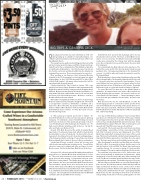
Dick & Carol Latvala, circa 1975 LATVALA ARCHIVES: carollatvala.com
Kidd fed him beer and took him backstage, where he was introduced to the road crew. The music soothed Dick’s nerves and he soon loosened up. The Dead’s notoriously unfriendly roadies were amused by this strange man with the gravelly voice, the acid sparkle in his eye and the manic obsession with their employers.
Once returning home, Dick reflected on his experience. The behind the scenes world of his favorite group looked very ap- pealing to him. He began planning trips to the mainland for concerts. He told his wife and friends he wanted to work for The Grateful Dead.
Dick attended more shows and got backstage easily, especially after he brought gifts of his dynamite Hawaiian bud for the road- ies. He made connections and met the band members. Percus- sionist Mickey Hart even visited once in Hawaii, where his host subjected him to hours of Dead tapes at full volume. Eventually Dick landed a job as a gofer and moved his family to California.
For years, Dick was The New Guy in the Grateful Dead or- ganization. He emptied trash cans, made coffee, washed cars, moved furniture and ran errands. He earned a credit on one of the Dead’s LPs: Dick Latvala — Caterer (meaning he drove to the deli and got sandwiches for the band). He paid some heavy dues.
Dick discovered he was the only Deadhead on staff. He would engage people in conversations about specific shows only to find they had no knowledge of the group’s history. For them it was just a paycheck. Dick had a hard time accepting that The Dead’s music hadn’t affected these folks the way it had him. Still, he kept trying.
One day in 1985, Dick was talking to head secretary Eileen Law about one of his favorite shows from 1968, a tape of which he just happened to have in his pocket. Mid-spiel, he realized someone was standing behind him and turned around. It was Grateful Dead bass player Phil Lesh. Dick screwed up his cour- age and said: “Hey Phil, I got a tape you should hear.”
Lesh said OK. The bassist spent the next three hours listen- ing and talking. Several times in their conversation Dick told Lesh that he hoped someone was taking good care of The Dead’s tape vault, which contained over 20 years of live record- ings. This music had made him a better human being and it was important that future generations could have the same experi- ence. The tapes were historic and should be treated as such.
After showing up for work the next day, Dick was called into Phil Lesh’s office. He nervously sat down. Had he gone too far with his fandom? Lesh told Dick The Dead’s tape vault was in complete disarray. No one was in charge of it and very little was catalogued. The tapes numbered well into the thousands.
The vault had only existed since 1976. Before then, reels were stored randomly in warehouses and basements. Many disappeared or were destroyed this way. After returning from a tour, The Dead’s soundmen would chuck the live tapes in the vault and forget about them. This had been going on for years.
Phil was impressed with Dick’s encyclopedic knowledge of their concerts. He had discussed the matter with the band last night and they had decided to create a new position in their company: tape archivist. Dick was the right man to fill that spot.
Dick Latvala couldn’t believe his luck. Cataloguing Grateful Dead shows was the only thing he knew how to do well (be- sides growing weed) and now he was getting paid to do it for
26 • FEBRUARY 2015 • the NOISE arts & news • thenoise.us


