


Page 17 - the NOISE July 2014
P. 17
tEACuP
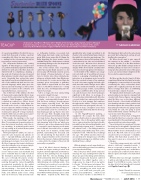
FROM FAR LEFT: Tina Mion’s “Memento Mori” Exhibit at CCA includes a large triptych, Carry Us All (panel
3 & detail of panel 1); a series of “Spectacular Death Spoons” (full & detail); and prints of the artist’s by iconic Stop Action Reaction, the original of which is housed at the Smithsonian National Gallery.
SArAH GIAnellI
of a year-long exhibition for which it was se- lected from thousands of entries, a portrait competition Ms. Mion has won twice now — making her the only repeat (and only Ari- zona) artist to ever be represented.
The self-portrait illustrates the coming together of what began as a creative exer- cise; and the naturalistic, figurative work that defined her work prior. Ms. Mion had com- mitted herself to completing a drawing a day, and, out of laziness she says, she would draw whatever random objects were within reach. Eventually they evolved into paint- ings (which form the most light-hearted sec- tion of the exhibit) and then into her own personal language, which plays upon the objects’ personal meanings as well as their universal associations in the collective, and especially American, consciousness.
Also in the foyer of the exhibit, is the first of many works expressing Ms. Mion’s deep concern for the environment and the animal kingdom. Called Arrogance, a family sits in a washed up rowboat in a lifeless, desert landscape. A walrus-like father figure has his head in the clouds, so self-absorbed he doesn’t realize the child he’s holding is dead. A toy elephant is tipped over in the sand rep- resenting the dying off of large mammals. Only the child’s eyes are wide open in aware- ness of the dire fate facing mankind.
“What sparks my paintings is the need to say something, or many things,” says Ms. Mion. “For a painting to be great you have to have the technical excellence, and it has to say something. A technically perfect work can say nothing at all, and an abstract paint- ing can say everything.”
Moving through the exhibit, one starts to notice the same characters and symbolic ob- jects — especially birthday cakes, boats, and old fashioned telephones — popping up in the paintings again and again. As we start to learn Ms. Mion’s language, they begin to build a nar- rative that culminates in an enormous triptych that is the grand finale of the exhibition.
But given the nature of this exhibit, one is in no hurry to arrive at its inevitable end, and is reminded that it’s really not about the destination, but the journey, which, in this case, is through the psyche, creative evolution and convictions of Ms. Mion. Me- andering through the Center, thoughtfully reconstructed specifically for this exhibit, the first area is dedicated to Ms. Mion’s large pop art paintings — faces made out of pep- permint candies, cherries, dice, lemons and shells; and subdued pastel scenes config- ured out of innocuous odds and ends such
as clothespins, buttons, rose petals, but- terfly wings, bent nails, Q-tips and bowtie pasta. With clever names like It’s Always the Butler (depicting the classic murder scene); and Bad Timing (for a fatal trapeze accident), the drawings manage to be cute despite the morbid scenes they portray.
One of her newest series of paintings, called “Spectacular Death Spoons,” is a hu- morous play off of kitschy souvenir spoons, but instead of being mementos of vaca- tions to historic sites, they commemorate infamous celebrity deaths. Amy Winehouse has the body of a cocaine spoon; Marie An- toinette’s spoon incorporates a guillotine; Sylvia Plath’s is topped with an oven mitt; and so on. Ms. Mion is in there too — being eaten by a lion, and disappearing into the funnel of a tornado.
“Life is so tragic, the most rational thing you can do is laugh,” she says.
Moving on to more serious territory is a timely, environmentally-charged piece that has been evoking a strong response from viewers, especially locals. Ms. Mion was working on a small painting and was so distressed by the Slide Fire she flipped it over and started a new one on the back. “I kept hearing people say that no lives were lost,” she says. “And I thought, many lives were lost, they just weren’t human lives. We lost many homes, they just weren’t human homes.” Ashes, painted in the Tromp de L’oeil style (meaning “trick of the eye” which uses shadow to give a three-dimensional effect), is a turquoise panel depicting an elk made out of delicate china and bones; a stylized tree made out of matches, mostly extin- guished, representing the deceased; and one still smoldering for that which is still alive. Snapped matches in the corner form birds in the manner a child would draw them
— reduced into the simplest of lines but still universally recognizable.
One of Ms. Mion’s charcoal drawings (a medium she began working in while heal- ing from a broken right hand and found less strenuous than painting) was also inspired by the Slide Fire. She was thinking about all the animals that died and began Make a Wish, a realistically rendered floppy-eared rabbit blowing out a birthday candle. Char- coal allows her to work in a looser style that comes out like a stream of consciousness, or, more accurately, unconsciousness.
Perhaps the most representative of a tradi- tional Memento Mori painting is a piece called Way Station. Inspired by Ms. Mion’s late
grandmother who slowly succumbed to Al- zheimer’s, the central female figure stands in the middle of a desolate, gray landscape. The elderly woman is dressed in traveling clothes, a wheelchair by her side, and a bewildered look in her eyes. We know she is deceased because she doesn’t cast a shadow. A phone dangles off the hook outside a nearby trailer and a neon motel sign glows in the distance.
In the middle of the exhibit is an octago- nal room built out of wood-framed screens. Inside is a grouping of paintings that all take place in an imaginary motel room Ms. Mion has revisited in many of her paintings. In each is the same sagging bed and ochre walls, but with subtle changes and a differ- ent scene outside the window. An explora- tion of the passage of time, each painting takes place at different time of day and sea- son, and showcases four desert landscapes significant to Ms. Mion. In an image of a flooded Sedona at dusk (where Ms. Mion has a second studio), two expressionless figures float by in a boat, imagery that reappears throughout the exhibit. “I believe every hu- man has their own spirit guide,” she says. “I put mine in boats, a metaphor across many religions and cultures that after we die we go on a boat ride.”
this tiny planet. We’re all on the same merry- go-round. We’re all going to end up, at least briefly, in the same place.”
Ms. Mion doesn’t want to give away all the surprises in the exhibit — and there are many. Besides, if, as Ms. Mion believes, where we go after death is unique to the in- dividual, perhaps it’s best not to reveal too many specifics about her vision of this place, so you can envision what it might look like for you, before experiencing hers.
Ms. Mion got the idea for Carry Us All after completing A New Year’s Eve Party for Suicides in Purgatory, a controversial piece (especially considering the older, conservative demo- graphic who regularly patronize the hotel where it hangs) that takes an unblinking look at the taboo subject of suicide.
The triptych, which dominates La Posada’s grand reading room, depicts a banquet hall crowded with famous figures representing what Ms. Mion sees as the three different kinds of suicide — the violently self-inflicted; slow death by substance abuse, and the Jack Kevorkian right-to-die variety. When people kept asking her what she was going to paint next, finally she said, “I’m going to paint what’s behind that curtain,” referring to an easy to miss exit in the painting.
In addition to her fair share of disgusted hate mail, Ms. Mion has received an outpour- ing of gratitude for this painting from people whom suicide has touched personally.
In the Flagstaff-inspired painting, a
slaughtered elk occupies the bed, while
outside a shed beckons in a peaceful snowy
landscape. Also in this gallery within a gal-
lery, is a piece about her last trip to the Mo-
javewithherlate,beloveddogNeedles;and “I’mnotdoingittobesensational,”shesays.
a particularly poignant work — featured on this edition’s cover — The Calling, in which a nun strides purposefully away from a lone telephone booth. “I like the idea of callings,” she says. “We all find ourselves where we are and what we’re doing because of it. Why am I in Winslow living in an old Mary Coulter building? It was a calling.”
Without giving too much away, finally you arrive at the painting you have been winding your way toward all along.
“This is the place where all the characters wind up,” she says, standing before Carry Us All, an epic piece that brings all the themes, symbols, imagery and characters scattered throughout the exhibit together onto a single canvas too large to fit on any wall in La Posada. “It’s that space in between,” she says. “You leave your mask; you leave your suitcase, everything you won’t need any- more — your credit cards, your pills, your car keys, your paintbrushes ... which are sad for me to leave. Our life is so brief. We’re on
“I’m doing it to be thoughtful. If people have a reaction it’s because I’m touching a nerve. What would be worse is if they had no reac- tion at all. My work seems to act as a Ror- schach test for a lot of people — it bubbles stuff up. But that’s what an artist does — they want to open up a conversation, start a dialogue.
“I don’t like seeing parents who can’t talk about a child who committed suicide. I hate to see people or animals in pain. If I can do anything with my art, I would like to ease people’s pain a little bit, make them a little less grave and maybe even make them laugh.”
Memento Mori runs through September 6, with an artist talk and tour on July 10 and August 15 at 5:30PM at Coconino Center for the Arts, 2300 N. Fort Valley Road. For details visit FlagArtsCouncil.org.
| sarah gianelli is a maven of spectacular spoons. arts@thenoise.us
thenoise.us • the NOISE arts & news • JULY 2014 • 17


