


Page 18 - the NOISE July 2014
P. 18
C
C
D FRoM 17
on
o
nt
t
in
i
n
u
u
E
E
D
The “Calla” series from Judith Skinner is among the notable works of craft & art at the Gallery In Williams.
DissoLVing thE RuLEs to ARRiVE in thE MoMEnt: thE PhotogRAPhy oF hARun MEhMEDinoViC
by SArAH GIAnellI
Harun Mehmedinovic may be relatively new to Flagstaff and NAU, but the 31- year old Bosnian-American’s work in film and photography is already known throughout the world. A graduate of UCLA School of The- ater, Film & Television; and the American Film Institute, Mr. Mehmedinovic has worked on dozens of award-winning films as director, screenwriter, actor and cinematographer, and was recruited by NAU for his profession- al experience and rare qualifications to teach both photography and film. Having just completed his first academic year as a pro- fessor, Mr. Mehmedinovic has big hopes for the department — one of which is to insti- tute the nation’s first college level astropho- tography class, and where more fitting than in the world’s first International Dark Sky City.
Landing a job at NAU could be seen as co- incidence, or fate a long time in the making. Mr. Mehmedinovic remembers his imagina- tion being ignited by the landscapes of the Southwest as a boy in Bosnia, when he was introduced to the region through the unlike- ly medium of Italian comic books.
“The way I met Arizona and the Four Cor- ners area was through these incredibly rendered cinemascope drawings,” he says.
“When I came here and actually saw the landscapes come alive it was a magical ex- perience. People who were born here may take it for granted. But I think when you’re coming from someplace else, there’s no way you’re going to come through here and not have your jaw drop constantly. There is a reason why these tribes settled here — it’s a holy land, a holy landscape. It’s also the place people in other parts of the world think of when they think of the US. They met it through the legend of the West, a symbol of freedom and the ability to control your destiny.”
But a lot would transpire before Mr. Mehmedonovic would find himself living and teaching in Northern Arizona. He would narrowly survive four years of the Bosnian War — the singularly most formative expe- rience of his life — before fleeing the coun- try with his family at age 13. They arrived in Phoenix, where they had distant relatives, and later moved to Washington DC where Mr. Mehmedonovic would finish high school before heading out to LA for film school.
During the 12 years Mr. Mehmedonovic lived in Los Angeles, he took frequent road trips through Northern Arizona and the sur- rounding areas to shoot the landscapes he daydreamt about as a child.
“While immersed in film, photography was a form of escape,” he says. “It was a way to disconnect, a solo activity. In film, you’re dealing with so many people, it wipes you out. You just want to decompress and re- charge.”
He enjoyed the peacefulness of photog- raphy so much that, ignoring the discour- aging remarks from his film community, he decided to shift his focus to the medium, but instead of landscapes, he decided to work with people. While traveling around the country on the film festival circuit (his film In the Name of the Son premiered in Telluride and went on to win 30 international awards), he would meet up with old friends with the idea of doing a shoot, but leave the day en- tirely up to them. If there was any structure at all, it was to do away with structure; and transport them to an idyllic feeling of child- hood — of carefree freedom, and complete presence in the moment.
“I would always treat it as a day of what- ever they wanted to do,” he says. “And if nothing materialized in terms of pictures, it didn’t matter to me. These were my close
friends, who I would hang out with any way. This was the difference between meeting them at a coffee shop and going for a walk, or them having an idea they wanted to do for years and never had a chance to do, or a dream they wanted to enact. Or they could have no idea what they wanted to do, and we would just see what happened. Initially, none of these people were in the arts; they were professionals — lawyers and doctors — who worked in very structured environ- ments. I threw a little challenge to them. If there was any rule to it, the idea was to di- vorce yourself from time. I wanted them to experience that for a while, because they’d been in the same tracks, headed in the same direction, for so long.
“It was very clear to me what it was from the beginning,” he says. “It was a way to go back to when you were a kid — especially in the summer, out in the country, taking the whole day, no questions asked. As a kid, I certainly knew what living in the moment was ... in the experience of war I became hy- peraware of it. Then it wasn’t just going out and having fun, but with a potential conse- quence.”
Eventually the series developed into the Bloodhoney project, a name derived from two Turkish words: Bal meaning “blood,” and Kan meaning “honey,” that refers to the bit- tersweet duality of life and the sublime spon- taneity captured in his photographs. “I’ve always been attracted to that idea,” he says.
“As you go through life, you always have both ends of it. You have really sh*tty periods and then really beautiful periods. When you’re in the beautiful periods you have to appreciate them, but in some way you have to appreci- ate the sh*tty periods too — it’s tough, but you’re going to get through it.”
Funded by a successful Kickstarter cam- paign, three and a half years and nearly 700 images later, the images started to coalesce naturally into themes, lending themselves to individual books, the first of which, Séance, was published in 2013. The hardcover pho- tography book includes the stories (written by Mr. Mehmedonovic) behind each of the 35 shoots and the mostly solitary women featured in striking landscapes that span the extremes of the urban and the wild, and scenarios that range from the playful to the perilous.
“The stories I’m interested in always come back to questions of identity,” he says. “I think that comes from the experience of war — it makes you question everything. You see this system you grew up in, this country with a flag and a culture ... and then you realize it’s all smoke and mirrors. I came to realize that a lot of ideological devices were about grab- bing onto some feeble identity. I stopped looking at myself so much as a Bosnian person, and the whole world became a play- ground.”
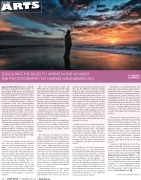
A selection of Mr. Mehmedonovic’s photo- graphs from the Bloodhoney project, as well as landscapes and night sky photography will be on display in the first formal Flagstaff showing of his work at photographer John Running’s Aspen Avenue Gallery for the duration of July. An opening reception will be held during First Friday ArtWalk from 6-9PM at 111 E. Aspen Avenue, Ste. #3 in downtown Flagstaff. To see more of Mr. Mehmedonoiv’s work, and to watch his TED Talk about the Bloodhoney project called “Living in the Mo- ment,” visit bloodhoney.com.
| have art? arts@thenoise.us
18 • JULY 2014 • the NOISE arts & news • thenoise.us


