


Page 28 - the NOISE July 2014
P. 28
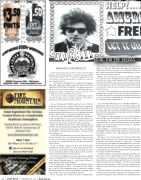
ARMAnD sChAuBRoECK
[Forty long years ago in 1974, music criticism’s Big Pappy Lester Bangs wrote a satirical essay entitled “How To Be A Rock Critic”. One of his suggestions was to find the most arcane band or artist no one has
ever heard of and:
“... TALK ABOUT THIS BUNCH OF OBSCURE NONENTI-
TIES AND THEIR RECORD(S) LIKE THEY’RE THE HOTTEST THING IN THE HISTORY OF MUSIC! You gotta build ‘em up real big, they’re your babies ... someday their true greatness will be recognized and you will be vindi- cated as a seer far ahead of your time.”
As much as I hate to embody a stereotype, I think I found my guy. One of them, anyway. His name is
Armand Schaubroeck. Thanks, Lester.]
Armand Schaubroeck (SHAW-brook) was born in 1944 in Irondequoit, New York, a suburb of Rochester. His father Ar- mand Sr. returned from Guadalcanal with severe shell shock and spent the remainder of his life in a VA hospital. Armand’s mother raised her four kids the best she could while working full time, but her eldest son grew up a child of the streets.
On the eve of his 18th birthday, Armand was convicted of a rash of petty thefts. He spent a year and a half in Elmira Cor- rectional Facility and another year and a half on parole. The experience made quite an impression on the young man.
When the British Invasion hit in 1964, Armand and his brothers started selling musical equipment out of their moth- er’s basement. They named their venture House Of Guitars (HOG). Within a few years, they moved into a storefront. And then a bigger one.
In the 1960s, your typical music shop had all their wares be- hind locked glass cases. Customers were not allowed to play or even touch them before purchase. None of these stores would take in second hand items for fear their stock would appear cheap.
House Of Guitars changed all that. Not only did the Schaubroecks permit anyone to bash away at their inven- tory, they encouraged the trading of used instruments for in- house credit. They added records, t-shirts, posters and other music-related merchandise to their shelves.
In the heart of the hippie era, a Texas advertising company had erected billboards of a freaky looking young man next to the legend: “Beautify America — Get a Haircut!” Many US newspapers proudly carried the photo.
The Schaubroecks designed their own billboard, which read: “Help Keep America Free — Let It Grow! House Of Gui- tars - Home For The Longhaired” next to a picture of a frizzy- headed Armand. The incident made Walter Cronkite’s news- cast, and the store received nationwide exposure.
House Of Guitars also contained a small recording studio
and record label. Armand and his brothers self-released two singles in 1964 and 1965 under the names Kack Klick and Churchmice. Running a business soon took put the brakes on their career as musicians, but Armand started work on a rock opera based on his time in prison.
Demos were recorded and passed around the industry. One made its way to Andy Warhol, who expressed interest in turning it into a play or film. Warhol had recently been aban- doned by the Velvet Underground and was looking for anoth- er musical project to nurture. Armand Schaubroeck prepared to be groomed into the next Lou Reed “street poet” and all systems were go.
On June 3, 1968, Andy Warhol was shot by radical feminist wingnut Valerie Solanis. He survived, but just barely. Most of his future plans fell by the wayside, and Armand’s prison op- era was one of them. Undeterred, the Schaubroecks decided to record and put it out themselves.
A Lot Of People Would Like To See Armand Schaubroeck ... DEAD finally appeared in 1972 on the brothers’ Mirror label. The front cover was of Armand in a jail uniform with a bul- let hole in his forehead and blood spilling down his grinning face. The 3 LP set was mixed in Quad and credited to Armand Schaubroeck Steals (ASS).
The album’s six sides demand two hours of the listeners’ time, just like a movie. Armand’s story unfolds: his days as a teen hoodlum, his capture, sentencing, incarceration, and eventual release. The tracks alternate between spoken word playlets and songs. Armand delivers his lines in a flat Noo Yawk T’oity T’oid Street drawl.
A Lot Of People ... is openly critical of American prisons. Any rehabilitation their inmates may experience comes despite the system’s pointless rules, sadistic guards and clueless ad- ministrators.
We meet some colorful characters in the joint like State Public Relations Director Mr. Tomato, State Psychologist Dr. Liederman, and inmate Howard Q. Sappy, who is rescued from suicide by a beautiful streetwalker who turns out to be a man. The kid in the cell next to Armand’s, sent up for a crime he didn’t commit, hangs himself on Christmas Eve. After dis- covering his body the next morning, Armand begs the guards (in song) to “Cut My Friend Down.”
The whole thing is corny and melodramatic and a little over the top, yet it has a certain dorky cool. It’s almost a parody of the Velvets or Transformer. The dialogue walks the line be- tween ridiculous and touching, while the music is by turns inept and inspired. A Lot Of People ... fits into no discernable category, but the album is so full of honesty and humor and compassion that the listener can’t help but be drawn into its world.
Armand Schaubroeck hawked his masterpiece by taking out ads in the back of music magazines and mailing copies to any interested parties. Also in 1972, House Of Guitars perma-
28 • JULY 2014 • the NOISE arts & news • thenoise.us


